

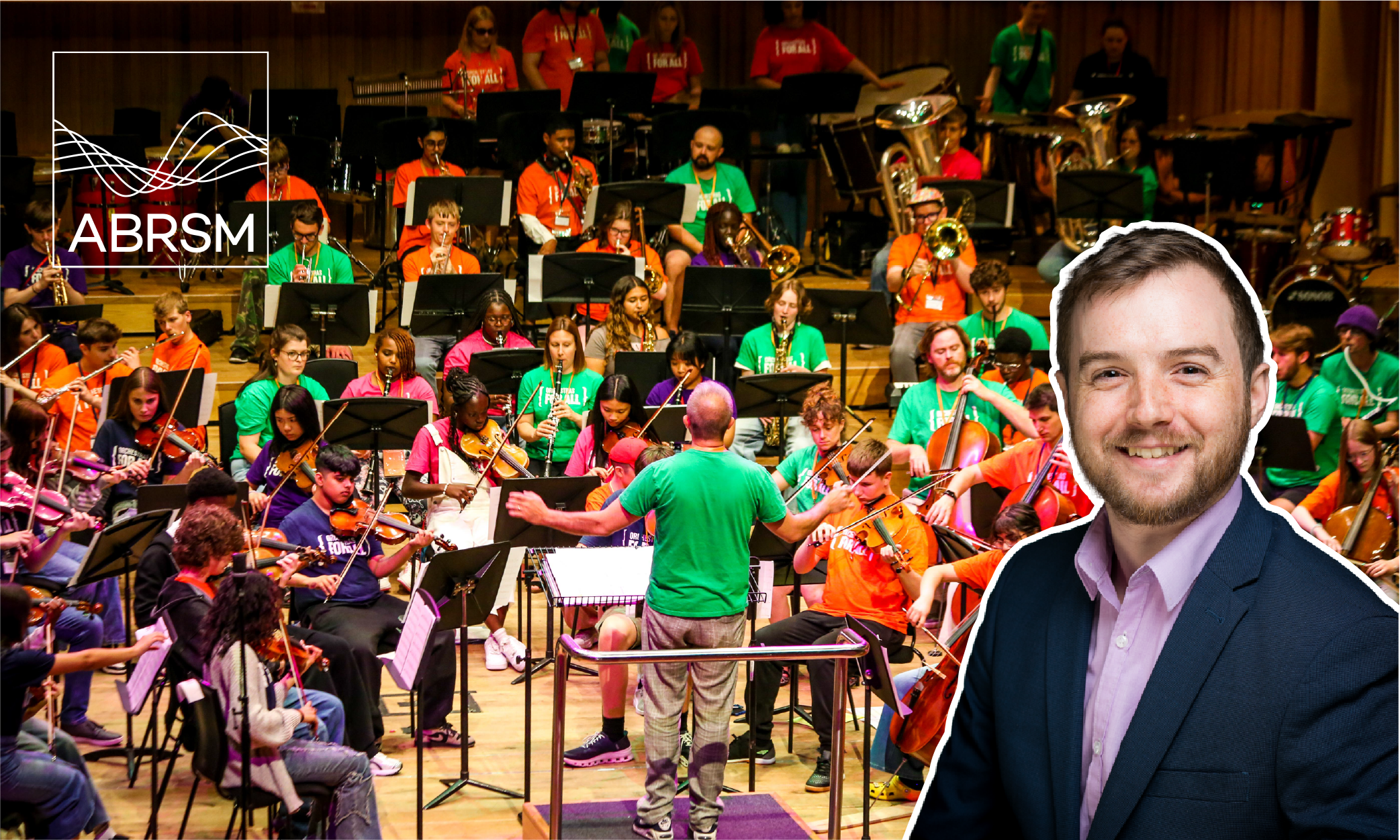
At Orchestras for All, we love the fact that there are so many different ways to celebrate progress in music, and for some young people, graded music exams can be one of them. We also know that exams can feel like a big step in your musical journey, especially if you don't know anyone who's been through the process before.
That's why we spoke to James Welburn from ABRSM to chat about everything from what happens on exam day to preparing, managing nerves and remembering that an exam is just one part of a much bigger musical journey.
1. Please could you introduce yourself
I’m James Welburn, Deputy Head of Engagement at ABRSM, as well as a composer, pianist and guitar player. I’m part of ABRSM’s Engagement Team looking after partnerships and programmes for next generation musicians. Our engagement activities are an exciting part of our work as a global music education charity.
2. For someone completely new to music exams, what different types of assessments does ABRSM offer, and how do they suit different kinds of learners?
We offer a wide range of exams and assessments for musicians of any age or stage in their learning, from the Prep Test and Initial Grade for beginners to Diplomas in Performance, Teaching and Directing. Assessments are available for all kinds of instrumentalists and singers. We also offer Music Theory exams and Creative Musicianship qualifications in Composing, Music Production and Songwriting. Candidates can often choose from face-to-face and digital options.
3. How do exams develop as you progress through the grades? What really changes from grade to grade?
Our exams encourage the development of a wide range of musical skills, knowledge and understanding.
Our Practical Grades allow learners to demonstrate skills in performance, as well as technique, notation, listening and musical perception. Our digital Performance Grades provide an opportunity to demonstrate skills in delivering a whole performance, communicating musically over a sustained programme. In both routes, each grade is progressive and represents a new challenge for the learner, providing motivation and structure to develop their musical skills.
Read more: 11 groundbreaking black composers you’ll wish you’d discovered sooner
4. What skills do exams help build beyond just musical ability?
All sorts! Any performance – including one where the audience is an examiner – helps to develop confidence and communication skills. If you’re playing with an accompanist, you develop listening and teamworking skills. And if things don’t quite go according to plan, it can develop resilience and the ability to keep going.
5. Exam nerves can be a big barrier for us all, what are your top tips for managing anxiety on the day?
Kate Andrews, one of our Chief Examiners, talks about this in her blog, ‘Unpacking performance anxiety’, and we share some top tips on our website here.
For me, I always start with the fact that I love playing music – what a joy to be able to share that with other people! This immediately helps to settle some nerves as I know I’m going to be doing something I really enjoy. For exams it helps to feel fully prepared, while recognising that you can’t control everything that happens. What you can control is your approach to practice, the pieces or songs you choose, and how confident you feel with any supporting tests: scales and arpeggios, sight-reading and aural.
6. Can you walk us through the full exam experience, from booking to receiving results?
We have lots of guidance available on our website about this, which will be informed by your choice of exam.
If you’re taking a face-to-face exam, you’ll arrive at the venue ahead of your exam time and will usually have the opportunity to warm up before you enter the exam room. Our examiners are there to help provide the best exam experience they can for candidates – in fact, the examiner motto is ‘I’ll do my best to help you do your best’. They’ll greet you with a friendly hello and smile and help you get settled in – making sure the piano stool or music stand are adjusted correctly for you. Knowing that examiners are all musicians and often music teachers themselves can be reassuring – they want you to feel as comfortable as possible in your exam so that you can showcase your musical skills!
We aim to release results for Practical and Performance Grades within seven days – although this can take up to 28 days. You’ll receive an email when results are ready to view.
Read more: Supporting the next generation: why mental wellbeing is more important than ever
7. How long does an exam usually last, and does that change depending on the grade or format?
Exams vary in length depending on the grade and instrument, as well as to accommodate any access needs that candidates may have. A face-to-face Practical Grade 1 Piano exam is 12 minutes from start to finish – enough time to play three pieces and complete the supporting tests at this level. A Practical Grade 8 exam lasts for 30 minutes as the pieces are much longer. If instruments require tuning, exam slots are slightly longer.
Performance Grade exams, which are assessed from a video recording, have their own timings.
You can find full details in the qualification specification for your exam.

8. How does ABRSM work to make exams feel more welcoming and less intimidating, especially for first-time candidates? What adjustments or support are available to make the exam experience more accessible?
Our teams work hard behind the scenes to provide the best possible exam experience for candidates – many of us have taken music exams ourselves and know how important it is to have a welcoming and inclusive experience.
Our examiners all receive training that provides them with the skills to help candidates feel as relaxed as possible in face-to-face exams.
We also have a team of Honorary Local Representatives (HLRs) in the UK supporting our exam operations, from finding and booking suitable venues to working with the examiner to make everyone feel comfortable and welcome.
We have a wide range of options available for candidates with specific needs to ensure they are supported throughout their exam experience. We recently created some videos to bring this to life, featuring James Risdon, our Access Lead, and Kate Andrews, one of our Chief Examiners. Check the videos out here – and please do get in touch with us via specificneeds@abrsm.ac.uk if you’d like to ask about specific needs requirements.
9. What happens if you don't pass and how should you approach next steps?
While examiners cannot offer teaching tips or recommendations, the mark form comments are designed to offer a summary of what was presented in the exam. It’s often a really useful starting point for candidates and teachers to discuss the commentary and reflect on each section of the exam.
Read more: 2025-26 NOFA highlights from a NOFA member
10. What does effective exam preparation look like in the weeks or months leading up to the assessment?
Effective exam preparation will look different for each of us – and, of course, it’s always useful to think of exams as one part of a broader music education. Teachers are best placed to advise on practice tips and structures for individuals.
We do have a range of apps designed to help learners as they prepare for exams – from aural and sight-reading skills to scales and practising pieces or songs.

11. How do exam fees work, and what should you know before entering? Is there support for exam fees available, and if so, how could you go about accessing it?
Exam fees are reviewed and set annually and can be found on our website dates and fees page. We hope our exams and assessments are accessible to as many learners as possible.
As a charity, we offer an exam discount scheme in the UK. It’s designed to alleviate some of the financial barriers that families may face when accessing exams. The scheme is administered for us by Music Mark, the UK’s subject association for music education. Discounts are available through music services in England, Scotland, Wales, Northern Ireland, the Isle of Man and the Channel Islands, so you can get in touch with your local music service to find out more.
12. Are there alternative ways to progress musically beyond sitting graded exams?
Absolutely! Progression comes in many and varied forms – and learners can explore what progression looks like for them. For me, performing to new audiences, tackling a new piece of music, learning a new chord progression and playing with other musicians all offer opportunities to progress in my music making.
Read more: A look back on the 2025-26 NOFA season
13. Where can musicians go if they have questions or need guidance during the process?
You can always get in touch with us if you’d like any guidance or support, whether about the exams themselves or the practicalities of exam bookings. We’re available via email, phone and web chat, and of course there are lots of supporting resources on our website. Do also check out our brilliant content on Instagram, TikTok, Facebook, YouTube and LinkedIn that we hope will inspire a life with music!

A huge thank you to James and the team at ABRSM for taking the time to share their advice and insights with us. We hope this conversation helps answer some of those questions, reassures you if you're feeling a little nervous, and reminds you that music is about so much more than grades. Every single practice, performance and new piece you learn is something to be proud of, and we're here to cheer you on every step of the way!
If you'd like to find out more about ABRSM, including their exams, resources and support for learners, head over to their website to explore everything they have to offer.

